GLDMA is a professional company in the production and Research&Development of metal bending machine, cutting machines, Hydraulic press machine, mechanical press machine, rolling machine, ETC. Relying on the integrity management, strong credit, and strict quality control, our company has grown and developed into a famous and powerful company in very short time. Company product range covers more than 20 series, over 200 types of small, medium, and big sizes of press brake, CNC shearing machine, CNC hydro-servo bending machine, mechanical press machine, Ironworker machine, hydraulic press machine, rolling machine including models of QC11Y, QC12Y, WC67Y, WC67K, W11, W11S, W12, J21, J23, Q35Y, etc. All those machines are widely used in manufacturing automobile, telecom tower, light pole, utensils, computer, ETC. Company development strategy in the field of metal sheet processing industry, always following the market trend to meet the demand of clients, Always pay attention on the long term cooperation with client, Always keep the advantages of core competition in technology, service and management, Always respect our contract and keep our promise. To all clients: Your strict requirements of quality is the driving force of our effort. May our products and service bring you the joys of success. If you need a reliable punching machine manufacturer, then you are at the right place, next I will introduce the powerful punching machine manufacturer in China, GLDMA Group.
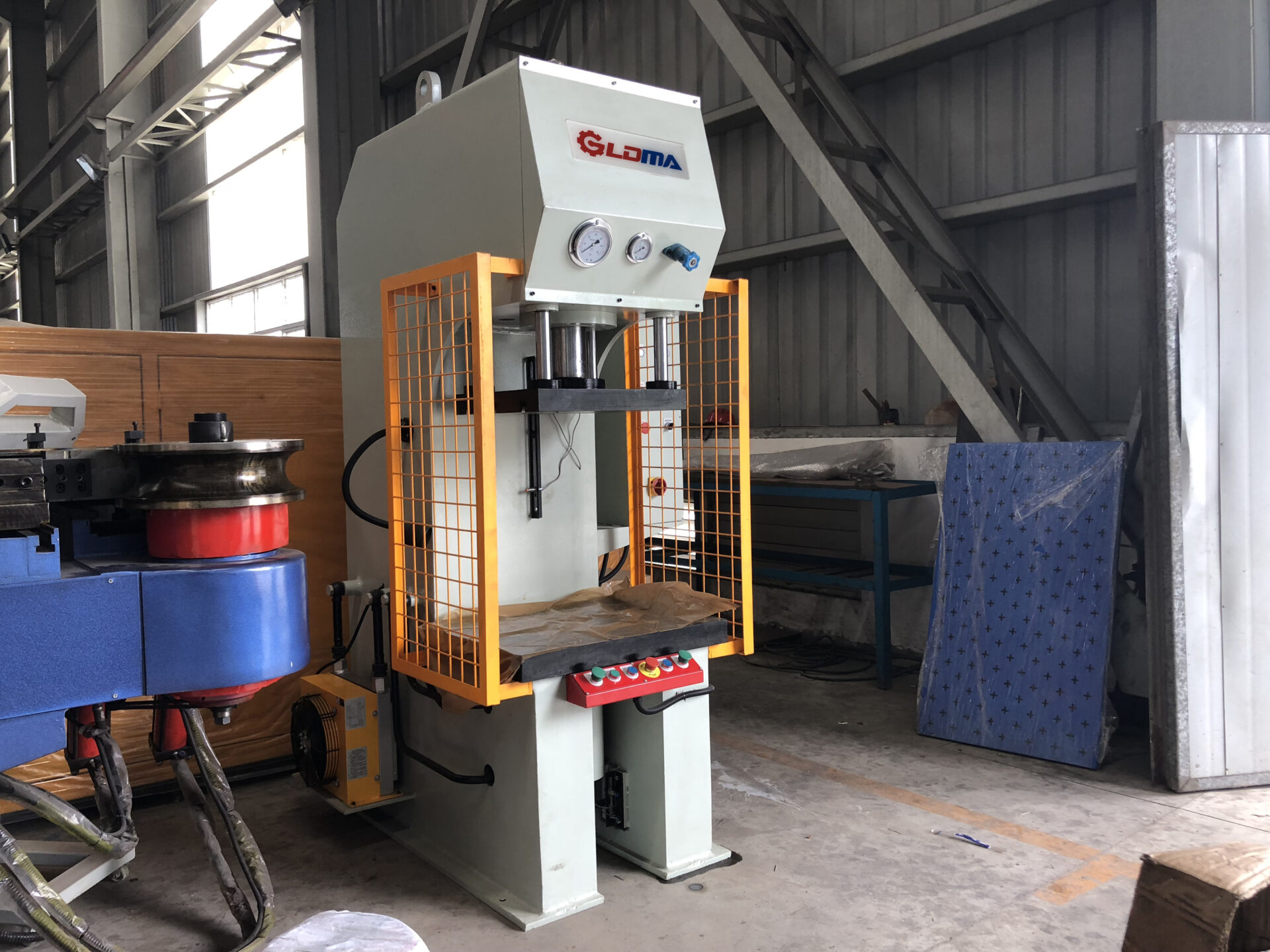
Hydraulic punching machine:
At present, there are many types of Punching Machines available in the market, and they are applicable to a wide range of scenarios. According to statistical analysis, the models that are most commonly used by most consumers are CNC Hydraulic Press, Pneumatic Punching Machine, Inclinable Punching Machine and Deep Throat Punching Machine. Below, I will introduce them to you specifically through their working principles, structural composition, working principles, advantages and application scope, hydraulic Press is a type of stamping equipment that CNC technology with hydraulic transmission technology.
Hydraulic transmission principle: Based on Pascal’s principle, which states that pressure is equal everywhere in a closed system. The motor drives the oil pump to operate, and the hydraulic oil in the oil tank is sent through the solenoid valve into the hydraulic cylinder. Due to the different areas of the pistons in the hydraulic cylinder, the small-area piston generates a smaller force, while the large-area piston can output a greater pressure, thereby driving the slider to move. CNC Principle: By inputting processing instructions through the CNC system, the parameters such as the on-off state, flow rate and pressure of each solenoid valve in the hydraulic system are controlled, thereby precisely controlling the movement speed, stroke, pressure and holding time of the slider, and achieving the automation and precision control of the stamping process. Body structure: There are mainly two types: closed and open. The closed body has good rigidity and can withstand large impact forces, making it suitable for large-scale workpiece processing and high-precision stamping; the open body is convenient to operate, with three sides open, which is convenient for mold installation and debugging, and is often used for processing small parts. Hydraulic system: It consists of components such as oil pump, oil tank, hydraulic cylinder, electromagnetic valve, and overflow valve. The oil pump pressurizes and conveys the hydraulic oil, the electromagnetic valve controls the flow direction and flow rate of the oil, the hydraulic cylinder converts the hydraulic energy into mechanical energy to drive the slider to move, and the overflow valve is used to regulate and stabilize the system pressure. CNC System: It is the “brain” of the Punching Machine. It is usually equipped with an industrial computer or a dedicated CNC device. It has a human-computer interaction interface, allowing for the input and editing of processing programs, controlling various actions and parameters of the Punching Machine, and also enabling functions such as fault diagnosis and alarm. Slider component: Connected to the piston rod of the hydraulic cylinder, it performs reciprocating linear motion under the drive of the hydraulic system. Its lower end is equipped with an upper die, and it works in conjunction with the lower die to carry out stamping processing on the sheet material. The motion accuracy and stability of the slider directly affect the quality of the stamped parts. Feeding mechanism: Common methods include ball screw feeding and gear rack feeding. It is driven by a servo motor and can precisely control the feeding length, speed and position of the sheet material according to the instructions of the CNC system, achieving automatic feeding.
The advantages of hydraulic punching machine:
High processing accuracy: The CNC system can precisely control the position and pressure of the slider, with high repeatability positioning accuracy. This ensures the dimensional accuracy and consistency of the stamped parts, and the processing accuracy can reach ±0.01mm or even higher. Pressure control accuracy: The hydraulic system can provide stable and precisely adjustable pressure. It can set and adjust the punching pressure within a certain range according to different processing materials and process requirements, meeting the needs of various stamping processes. Adjustable movement speed: The sliding block’s descent speed, pressing speed and return speed can be flexibly adjusted through the CNC system. This not only enhances production efficiency but also meets the speed requirements of some special processes. High degree of automation: It features automatic feeding, automatic mold changing, and automatic counting functions, enabling unmanned automated production. This not only enhances production efficiency but also reduces labor costs and physical strain, and minimizes the impact of human factors on product quality. Long mold lifespan: Due to the precise control of pressing force and motion accuracy, the impact and wear on the mold are minimal, which helps to extend the mold’s service life and reduce the costs of mold replacement and maintenance.
The application fields of hydraulic punching machine:
Automobile manufacturing: It involves stamping processing for automotive body panels, chassis components, engine parts, etc., such as doors, engine covers, frame longitudinal beams, connecting rods, etc. This can meet the production requirements of large-scale and high-precision for automotive components. Electrical Appliances: Components such as the casings, shielding covers, heat sinks, and connectors for electronic devices can be processed. They are suitable for the trend of making electronic components thinner and more precise. Examples include mobile phone casings, computer chassis, and transformer cores. Hardware products: Widely used in the hardware industry, such as processing various hardware components like door locks, hinges, handles, tableware, kitchenware, etc. This enables the realization of complex shapes and processes in stamping, thereby improving production efficiency and product quality. Aerospace: It is used for processing components in the aerospace field, such as aircraft wings, fuselage structural parts, engine blades, etc. The processing accuracy and quality of the materials in this field are extremely demanding. CNC hydraulic Punching Machines can meet these stringent processing requirements. Appliance manufacturing: For components such as the shells, inner cavities, and supports of household appliances like refrigerators, air conditioners, and washing machines, the stamping and forming process can achieve large-scale automated production, ensuring the consistency of product quality.
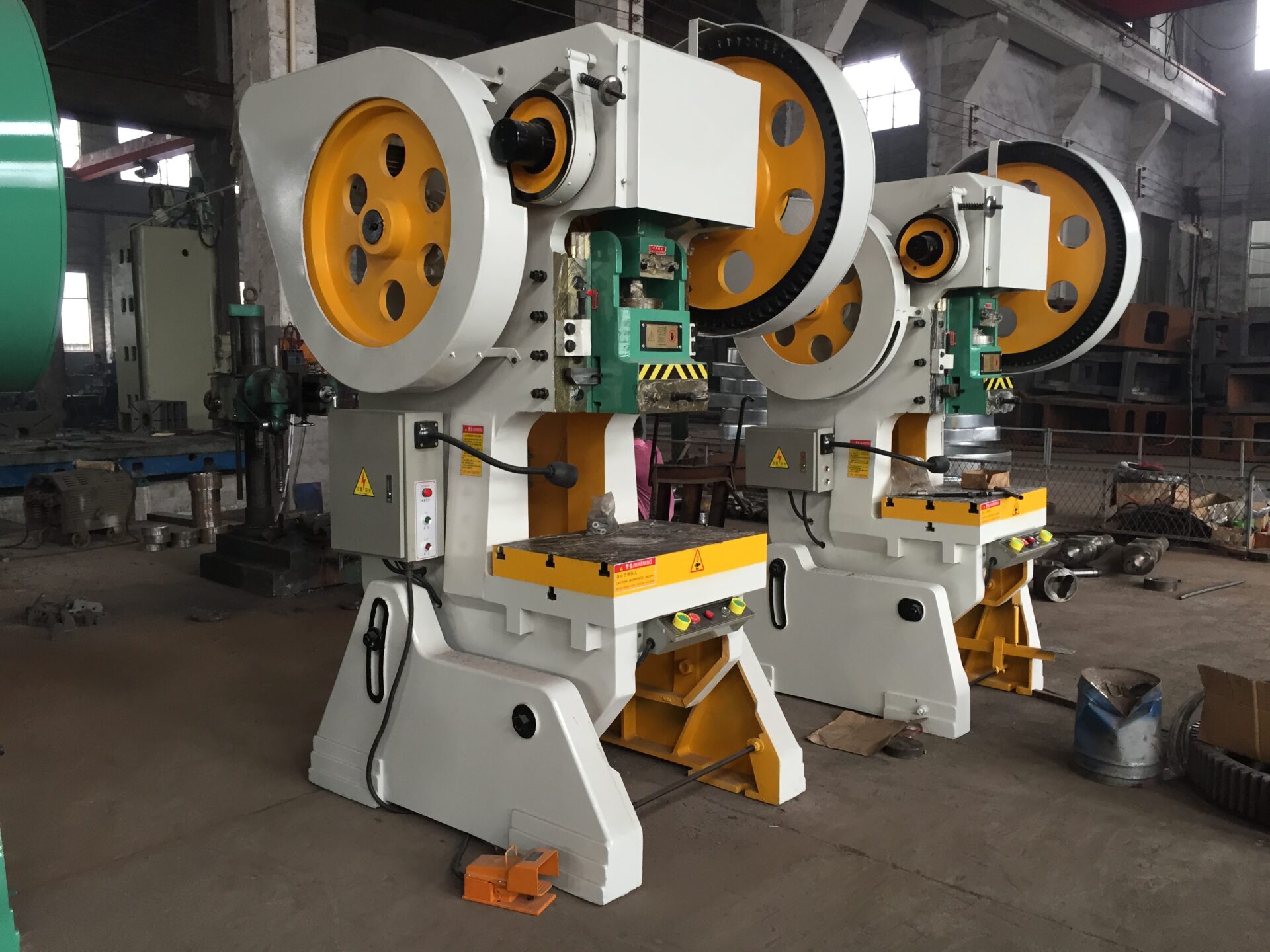
Mechanical punching machine:
The Inclinable Punching Machine is a Stamping press equipment with a tiltable body structure. Its core feature is that the worktable or the entire frame of the machine can be tilted within a certain angle range (usually 30° – 45°). By utilizing gravity to assist the automatic sliding of workpieces or waste materials, it has many advantages such as efficient material discharge, reduced manual labor, compact structure, flexible operation, lower cost, and easy maintenance. It is widely used in small and medium-sized simple stamping processing scenarios. However, it also has limitations such as a relatively lower pressure capacity (typically 10 – 100 tons) and limited accuracy. The pressure is usually 10 – 100 tons, and it is not suitable for thick plates (such as those over 5mm) or high-strength materials. The tilting structure may result in slightly lower rigidity of the machine body compared to closed-type stamping machines. Long-term use may cause slight deformation, affecting the stamping accuracy (suitable for parts with an accuracy of ±0.1mm).
The working principle:
Tiltable body design: The machine body is connected to the base through hinges or adjustment mechanisms, and can be tilted manually (for small machines) or hydraulically (for large machines). The tilt angle can be adjusted within the range of 0° – 45°. When tilted, the worktable forms a slope, and the processed workpieces or waste materials can slide off the worktable along the inclined surface, reducing the time for manual cleaning. Mechanical transmission is the main method: Most tiltable stamping machines use a mechanical transmission system: the motor drives the flywheel to store energy, and through the crankshaft and connecting rod, the rotational motion is converted into the up-and-down reciprocating motion of the slider, driving the die to complete stamping (punching, blanking, bending, etc.). The stamping frequency is usually 100 – 300 times per minute, suitable for small-batch continuous processing.
The structure composition:
Open structure, mostly “C-shaped” open machine body, with three open operation spaces on all sides, facilitating the loading and unloading of workpieces from different directions, especially suitable for manual or semi-automatic feeding of small parts (such as gaskets, small hardware parts).
The advantages:
The inclined function is the greatest advantage: the finished products or waste materials after stamping do not need to be manually cleaned. They slide into the collection box along the inclined tabletop by gravity, especially suitable for regular-shaped, lightweight parts (such as metal sheet products), which can increase the auxiliary operation efficiency by more than 30%. The open design combined with the inclined feature results in a small equipment footprint and lower requirements for the operator’s skills. It is suitable for simple stamping tasks with small batches and multiple varieties (such as the blanking of small hardware parts). The mechanical transmission structure is mature, with a manufacturing cost lower than that of hydraulic or CNC Punching Machines. Daily maintenance mainly involves repairing easily damaged parts such as flywheels and guide rails. The failure rate is low, making it suitable for small and medium-sized enterprises.
Applicable scenarios:
Small hardware products: blanking and punching of components such as gaskets, projectiles, and small hooks. Light industry: simple shaping of toy parts, metal components for stationery, and small parts for kitchenware. Electronic industry: primary stamping of small metal shielding covers and connector pins.
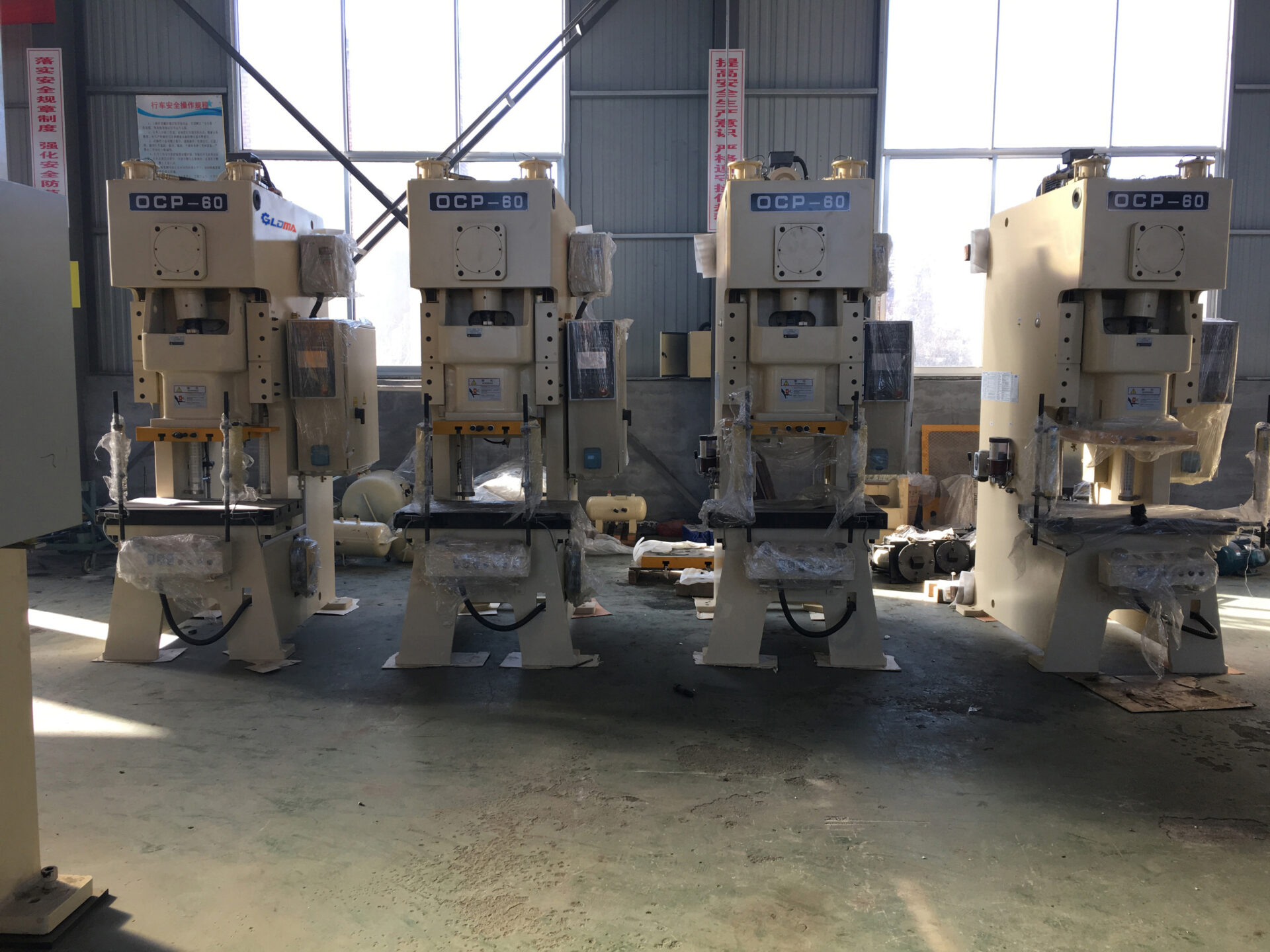
Pneumatic punching machine:
A pneumatic Punching Machine is a device that uses compressed air as the power source and is driven by an air system to complete the punching action through a slider. Its working process is based on the conversion of “air pressure energy → mechanical energy”. Pneumatic Punching Machines are widely used in lightweight punching scenarios due to their light weight, high efficiency, and low cost. Compared with mechanical Punching Machines and hydraulic Punching Machines, pneumatic Punching Machines have unique advantages such as high speed and low energy consumption, but they also have certain limitations. For example, the punching force is relatively small (usually not exceeding 100 tons), and the pressure stability is affected by fluctuations in the air source. They are not suitable for heavy plate and high-strength material heavy punching.
- Manual pneumatic Punching Machine: Requires manual feeding and pressing the foot pedal switch to start, suitable for simple and small-batch processing (such as hole punching of hardware parts).
- Semi-automatic pneumatic Punching Machine: Equipped with an automatic feeding mechanism (such as roller feeding, mechanical hand), only requires manual loading, with higher efficiency.
- CNC pneumatic Punching Machine: Combining with the CNC system, it can program control the slider stroke, speed and feeding position, suitable for precise processing of complex shapes (such as the forming of electronic connectors).
The working principle:
Air source supply: Compressed air is provided by an external air compressor. After passing through filters, pressure reducers and other pneumatic components for treatment, the gas is made clean and the pressure is stable (the working pressure is usually between 0.4-0.6 MPa). Power conversion: Compressed air enters the cylinder (in a single-cylinder or double-cylinder structure), pushing the piston to move. Then, through the transmission mechanisms such as connecting rods and crankshaft, the linear motion of the piston is transformed into the up-and-down reciprocating motion of the slider. Pressing operation: When the slider descends, it drives the upper and lower molds to close, completing processes such as punching, blanking, bending, and forming of the material; when the slider ascends, it returns to its original position relying on the return force of the spring or the cylinder, preparing for the next cycle. Control and regulation: The on-off and direction of the airflow are controlled by solenoid valves, foot-operated valves or CNC systems, enabling the start, stop, speed adjustment and stroke control of the slider.
The structure composition:
Frame: Mostly made of cast iron or steel welding, providing rigid support. It is divided into open type (with large operating space, suitable for small workpieces) and closed type (with stronger rigidity, suitable for slightly larger loads). Air source treatment components: Filter (removes water and impurities), pressure reducing valve (stabilizes air pressure), oil mist generator (lubricates pneumatic components). Actuating components: Cylinder (provides power, has single-acting and double-acting types, double-acting cylinders can control forward and backward movement in both directions). Control components: Electromagnetic valve (controls air flow direction), pressure relay (monitors air pressure, ensures safety). Slide block and mold mounting base: The slide block is connected to the cylinder piston, the lower end installs the upper mold, and the motion accuracy is ensured through the guide rail; the worktable surface installs the lower mold, which can be adjusted in height according to requirements. Operation and safety devices: Include foot pedal switch, two-hand start button, emergency stop button, protective cover, etc., to prevent accidental operation and potential safety accidents.
The advantages:
Fast response: The pneumatic system starts quickly, and the slider’s idle stroke speed can reach 100-300 times per minute, suitable for small and medium batch, high-frequency processing (such as punching of electronic components). Low energy consumption: It only consumes compressed air during operation, and there is almost no energy consumption in the standby state. The operating cost is lower than that of the hydraulic Punching Machine. Easy operation: The punching pressure can be controlled by adjusting the air pressure (the punching pressure is usually between 1-50 tons, suitable for light processing), no complex parameter settings are required, and beginners can easily master it. High safety: When overloaded, the compressed air can automatically relieve pressure to avoid damage to the equipment or molds; combined with the photoelectric protection device, it can effectively prevent workplace injuries. Simple maintenance: The pneumatic components have a simple structure and low failure rate. Daily maintenance mainly involves cleaning the air source, replacing the filter element of the filter, and lubricating the components.
Applicable scenarios:
Electronic and electrical industry: hole punching for mobile phone casings, circuit board cutting, connector pressing, battery shell forming, etc. Hardware products industry: stamping, bending, riveting of small hardware parts (such as screws, washers, hooks). Toys and daily necessities: metal parts for plastic toys stamping, zipper head forming, tableware stamping, etc. Automotive parts: batch processing of small automotive parts (such as snap fasteners, washers). Medical devices: lightweight stamping of precision medical parts (such as needle holder seats, instrument casings).